Parador - parapromotions- spain - quality accommodation

PARADORES - NORTH AFRICA - SPAIN

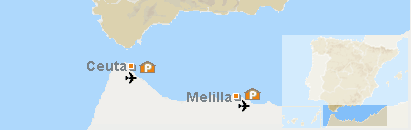
Click on a symbol on the map, or the links below, to see the full page for each Parador

Parador - North Africa
Parador de MelillaParador de Ceuta
Click here for information about North Africa

Ceuta
Melilla

PARADOR ACCOMMODATION IN NORTH AFRICA

Click on the name of the Parador for more information and, to make a booking

OVERVIEW IMAGE LOCATION BEDS
Parador de Ceuta
Luxury 4 star Parador hotel in the Spanish North African possession of Ceuta. Some
bedrooms of this modern building make use of the vaults of the old artillery stores.
Parador of Ceuta - North Africa -Spain (Spanish posession)
Ceuta
206
Parador de Melilla
3 star Parador hotel overlooking the town, bay and beaches of this
Spanish possession in North Africa.
Parador of Melilla - North Africa -Spain (Spanish posession)
Melilla
76
 - C E U T A - 

Set on an isthmus on the northern coast of Africa overlooking the Strait of Gibraltar, Ceuta is a city surrounded by the sea. An important port and commercial center, sometimes called the "Great Bazaar" because of its large number of stores, the city extends west from the Hacho Mountain, which juts out into the Mediterranean Sea and is said to be one of the legendary Towers of Hercules. From its heights, crowned by a fortress, exceptional views of the city, the Strait of Gibraltar and western Andalucia unfold, and at the outskirts of the city the Isabel II overlook provides memorable views.
 
Ceuta was a Carthaginian colony, later fortified by the Caliph of Cordoba Abd al-Rahman III. It was conquered by Portugal in the early fifteenth century and passed to Spain when Spanish King Philip II was also crowned king of Portugal. The Foso de San Felipe, a navigable canal that cuts across the isthmus, and the royal walls were built by the Portuguese and later expanded under Spanish rule.

Gastronomy
Because of Ceuta's proximity to southern Spain, the city has a very Andalusian appearance, and its fishing fleet is sizable. As one would expect, wonderfully fresh seafood is the highlight of the city's gastronomy, simply fried or grilled or in light sauces, all prepared in the style of Andalucia.

Attractions
Sights in Ceuta include the remains of the fourteenth century Arab walls and fortress, and in the outskirts of the city the Arab aqueduct Arcos Quebrados still stands. Ceuta's cathedral is built on the site of a sixth century Christian temple and although neoclassic in appearance, its original construction is fifteenth century. It features a lovely Renaissance portal of black marble and a baroque altar. In the elegant Municipal Palace the Throne Room displays the standard of the city and many archeological remains.

Fine beaches, a government parador in a lush garden setting adjoining the city walls, and a casino within the beautiful Parque Maritimo del Mediterraneo that was created by visionary Canary Island artist Cesar Manrique, are other enticing reasons to visit the city.

 - M E L I L L A -

For centuries the city of Melilla has been an outpost of Spain because of its strategic location on the peninsula of Tres Forcas on Africa's Mediterranean coast. In ancient times the city was occupied by Phoenicians and Carthaginians before it was integrated into the Roman Empire in the first century. When the Moors conquered Spain, Melilla became part of the Caliphate of Cordoba  and later reverted to the kingdom of Fez. Melilla declined in the Middle Ages, becoming a refuge for pirates, until it was conquered by the Catholic Kings at the end of the fifteenth century, and it has remained Spanish since then. Subsequent monarchs repopulated and fortified the city, and in the eighteenth century Melilla was further secured by numerous fortresses that still ring the city.
 
Today Melilla is a culturally diverse city and duty free port where languages mix and mingle. It is joined to the Spanish mainland by ferry and air service and boasts a fine mild Mediterranean climate similar to Spain's Costa del Sol. A municipal marina also makes it a center for sports fishing and other related activities, and an attractive government parador in the Old Quarter that has exceptional views of the city and its port is a fine place to relax when visiting the city. 

Gastronomy
Melilla's gastronomy, based on the exceptional fish and shellfish from nearby waters, is in essence Andalusian but with interesting Moroccan overtones, and the city is filled with tapas bars.

Attractions
Melilla's most striking feature is the Old City or Citadel -the original fifteenth century walled city of steep narrow streets at the highest point of the city that has been declared a historic-artistic monument. Entered by way of the Puerta de Santiago graced by the coat of arms of Emperor Charles V, the old quarter encloses three walled districts, separated from one another by deep moats and joined by bridges. Other sights include the Municipal Museum, housed in the Renaissance Concepcion Church where the visitor can relive the history of the city.

Text courtesy of the Tourist Office of Spain


Parapromotions- copyright